
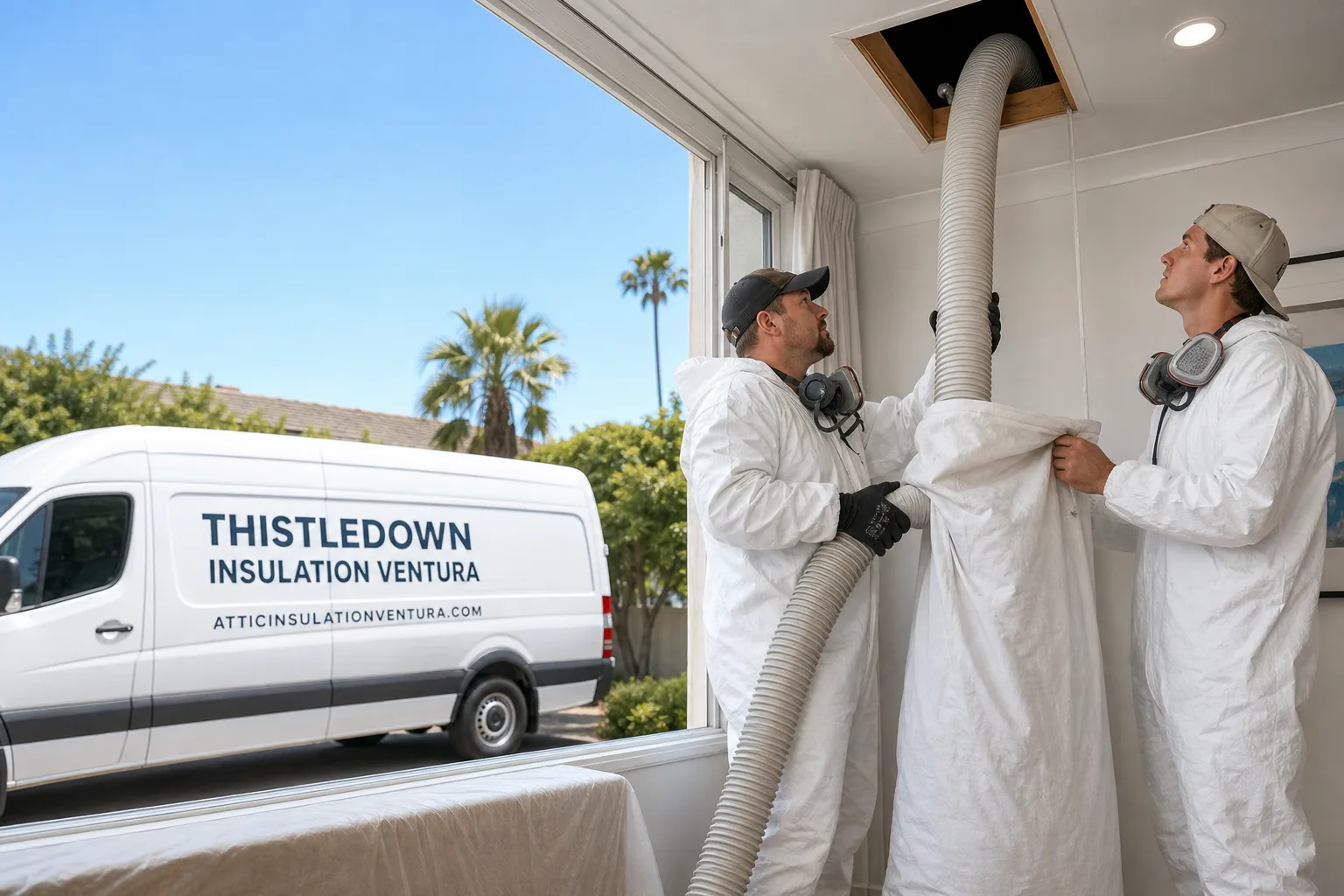
How Much Does Attic Insulation Cost in Ventura?
Attic insulation in Ventura typically costs between $1,750 and $4,800 for a standard 1,200 to 1,800 square foot attic, with most homeowners paying around $2,600 for blown-in fiberglass or cellulose. Spray foam insulation runs higher, usually $3,200 to $6,900, because the material and installation process are more involved. At Thistledown Insulation Ventura, you’ll get a written price for our Attic Insulation services before any work starts, so the number you approve is the number you pay.
These figures reflect what we’re seeing across Ventura, Oxnard, Camarillo, and the surrounding coastal communities in 2026. Your exact cost depends on your attic’s square footage, current insulation depth, access difficulty, and the material you choose. We’ll walk through each of those below.
Key Takeaways
- Standard blown-in attic insulation in Ventura: $1,750 – $4,800
- Spray foam attic insulation: $3,200 – $6,900
- Most common project size (1,500 sq ft attic, R-38 blown-in): $2,200 – $3,400
- Free estimates with a written price before work begins: call (341) 217-4867
Attic Insulation Cost Breakdown (2026)
Here’s how pricing breaks down across the attic insulation options we install in Ventura. These line items are based on a standard attic between 1,200 and 1,800 square feet with existing insulation that needs an Attic Insulation Top-Up or full removal. Your written quote will be specific to your attic, not a range pulled from a chart.
| Insulation Type | Typical Cost (1,200 – 1,800 sq ft attic) | Best For |
|---|---|---|
| Blown-in fiberglass | $1,750 – $3,200 | Most Ventura homes; quick install, good coverage |
| Blown-in cellulose | $1,900 – $3,600 | Homeowners wanting recycled-content material |
| Batt fiberglass (R-30 to R-38) | $2,100 – $4,000 | Attics with open joist bays |
| Spray foam (open-cell) | $3,200 – $5,400 | Air sealing plus insulation in one step |
| Spray foam (closed-cell) | $4,400 – $6,900 | Higher R-value per inch; moisture resistance |
| Attic air sealing (add-on) | $600 – $1,400 | Gaps around plumbing stacks, wiring, recessed lights |
These are installed prices, meaning the material, labor, cleanup, and our shoe-covers-and-drop-cloths standard are all included. If your attic has old insulation that needs removal before we install new material, that adds $1.50 to $2.25 per square foot in Ventura. Rodent damage, mold, or water-stained insulation pushes that higher.
What Drives the Price Up or Down
Attic access is the quiet cost driver most homeowners don’t see coming. If your attic hatch is in a hallway ceiling with good clearance, the job is straightforward. If the access is in a closet under a sloped roofline, or the attic has shallow joist bays that make movement tight, labor time goes up and so does the price. Homes in Ventura’s older neighborhoods, the Avenues, Midtown, and parts of East Ventura, often have tighter attics than the tract homes built in the 1990s and 2000s. That’s not a problem, it’s just a line item we’ll show you before we start.
Another factor is whether your attic has proper ventilation. Some Ventura attics, especially those with tile roofs common in Spanish-style homes near the hills, trap heat and need a ventilation review as part of the insulation upgrade. We check this on every estimate because insulation without air movement works against you, not for you.
What Affects Attic Insulation Pricing in Ventura
- Attic square footage. This is the primary driver. A 1,000 sq ft attic in a Ventura bungalow costs less than a 2,200 sq ft attic in an Oxnard two-story. Price scales almost linearly with square footage for blown-in materials.
- Current insulation depth. If your attic already has R-19 and you’re topping up to R-38, the job is faster and cheaper than starting from bare drywall. If the existing insulation is compressed, wet, or full of rodent droppings, removal costs get added.
- Material choice. Cellulose tends to run slightly higher than fiberglass in Ventura because of material handling. Spray foam is the most expensive but delivers air sealing in the same pass, which matters in coastal homes where marine air pushes through gaps.
- Access and attic layout. Low-slope roofs, tight hatches, exposed nails, and truss systems that block movement all add labor time. Midtown Ventura homes from the 1940s and 1950s commonly have tighter attic geometry than newer builds in Mission Oaks or Riverpark.
- Air sealing needs. Recessed lights, bathroom fan vents, and plumbing stacks all leak conditioned air. Sealing those before insulating adds cost but is one of the highest-return upgrades you can make in Ventura’s mild climate.
- Existing damage or contamination. Rat and mouse activity is a fact of life in parts of Ventura, especially near open spaces like Arroyo Verde Park. If we find contaminated insulation, NEST removal, or animal entry points during the estimate, those line items appear on your written quote, not as a surprise after the fact.
Insulation Types We Install and What They Cost in Ventura
Thistledown Insulation Ventura installs eight product lines, Owens Corning, Johns Manville, Knauf, Rockwool, CertainTeed, Icynene, Demilec, and GreenFiber. That matters because your attic, your family’s allergy profile, and your budget shouldn’t be forced into a one-size-fits-all product. Here’s how the main material categories compare on price and performance in Ventura’s coastal climate.
Blown-In Fiberglass
Blown-in fiberglass is the most common choice we install in Ventura. It fills irregular spaces well, resists moisture, and doesn’t settle as much as older cellulose formulations. For a 1,500 sq ft attic brought to R-38, expect $2,200 to $3,100. We use Owens Corning and Johns Manville blown fiberglass most often, because their coverage rates are consistent and the material holds its loft over time. Installation typically takes one day, and the attic is walkable for us but not for storage unless you add a raised deck.
Blown-In Cellulose
Cellulose is made from recycled paper treated with borate for fire resistance. It costs $100 to $400 more than fiberglass on the same attic size because it’s denser and the bags cover less square footage. Some Ventura homeowners choose cellulose because they prefer recycled-content material, and GreenFiber’s product is a good fit there. Cellulose also does a slightly better job at reducing sound transfer, which matters if your attic sits above bedrooms on a busy street like Telegraph Road or Victoria Avenue.
Batt Fiberglass
Batt insulation makes sense when your attic has open joist bays and no meaningful air sealing concerns. It costs more than blown-in because installation is more manual, cutting each batt to fit around framing, plumbing, and wiring. We carry Owens Corning, Johns Manville, Knauf, and CertainTeed batts. Expect $2,100 to $4,000 for a typical Ventura attic, depending on whether you choose R-30 or R-38.
Spray Foam
Spray foam is the premium option, $3,200 to $6,900 for a standard Ventura attic. Open-cell foam insulates and provides air sealing in one application, which is valuable in coastal homes where salt air finds every gap in the building envelope. Closed-cell foam adds a moisture barrier and higher R-value per inch, useful for attics with limited rafter depth. We install Icynene and Demilec spray foam products. One thing to understand: spray foam off-gasses during installation, so we schedule those jobs with ventilation and time the work carefully if anyone in the home has respiratory sensitivity. We’ll talk through that on the estimate.
Does Attic Insulation Actually Pay for Itself in Ventura?
Yes, but with Ventura-specific math. Our coastal climate is mild. You’re not fighting Minnesota winters or Phoenix summers. The payback comes from three places: reduced heating demand on cold winter nights, reduced cooling load during Santa Ana heat spells, and improved comfort in rooms that currently run hot or cold. Homes in the hills above Ventura, near Grant Park or up in Ondulando, see more temperature swing than homes near the beach, so their payback is faster.
On a $2,600 attic insulation job in a typical Ventura home, most homeowners see $25 to $55 per month in gas and electric savings, depending on the home’s age, orientation, and HVAC system. That’s a payback window of roughly 4 to 9 years. But the comfort difference is immediate: bedrooms stop running five degrees warmer than the hallway in summer, and the upstairs stops feeling cold in February. For families with a baby’s nursery or a toddler’s bedroom directly under the attic, that matters as much as the utility bill.
If you’re planning to sell within two or three years, attic insulation is also one of the few home improvements that appraisers and inspectors notice. An unconditioned attic with bare spots is a negotiation point for buyers. A freshly insulated attic with documented R-value is a quiet selling feature. We can’t tell you it adds exactly X dollars to your sale price, and any company that claims a precise number is guessing. But it removes a known objection, and in Ventura’s 2026 market, removing objections moves homes faster.
Why Air Sealing Matters Before You Insulate
Attic insulation doesn’t work as designed if air moves through the ceiling. In Ventura homes, the biggest leaks are recessed can lights, bathroom exhaust fans, attic hatches, and the gaps around plumbing vents. When conditioned air escapes into the attic, it carries moisture with it. That moisture condenses on rafters on cold nights and contributes to the exact problems you’re insulating against.
On most estimates, we include an air sealing line item, $600 to $1,400 depending on how many penetrations we find. If you’re on a tight budget, air sealing alone delivers outsized comfort gains for the dollar, because it stops the draft first. Then you can add insulation later. But if you insulate without sealing, you’re paying to trap air movement inside your attic, which is like wearing a down jacket with the zipper open.
Attic Insulation and Ventura’s Building Code
Ventura follows California’s Title 24 energy code, which sets minimum attic insulation requirements by climate zone. Ventura sits mostly in climate zones 6 and 7, which call for R-30 to R-38 in attics for new construction and major remodels. Existing homes aren’t required to upgrade unless you’re pulling permits for other work, but the code gives you a useful target: R-38 is the right number for most Ventura attics, and R-49 is worth considering if your home is in the hills where it drops below 40 degrees more often.
If you’re adding insulation as part of a permitted remodel, we work with your contractor to make sure the installed R-value meets the plan’s specifications and passes inspection the first time. We’ve done enough permitted jobs in Ventura to know what the inspectors want to see, and it’s rare for a pass to take more than one visit when the depth markers are in place and the baffles are installed correctly.
Signs Your Ventura Home Needs More Attic Insulation
You don’t need a thermal camera to know your attic insulation is tired. Here are the signs we hear on estimate calls in Ventura most frequently.
- Upstairs rooms run 5+ degrees hotter than downstairs. This is the single most common complaint in two-story Ventura homes. Heat builds in the attic and radiates through the ceiling.
- Your gas bill jumps in December and January. Ventura winters are short, but heating demand still matters. If your furnace runs constantly on nights below 50 degrees, your attic is a likely culprit.
- You can see your ceiling joists from the attic hatch. If the insulation level is below the top of the joists, you’re at R-19 or less, and you’re leaving performance on the table.
- Rooms with cathedral ceilings are uncomfortable. The geometry is different, but the fix is often similar: we can quote spray foam for ceiling cavities or a strategic insulation plan around the roofline.
- You find old fiberglass batts that are brown, compressed, or scattered. Original insulation from the 1970s and 1980s loses loft and effectiveness. Ventura homes built in that era often have R-11 batts that have seen better decades.
If any of that sounds familiar, the attic is worth a look. We don’t charge to come out, and you’ll have a written price in hand before we touch a rafter.
How to Save on Attic Insulation in Ventura
Saving money on attic insulation is about timing, material choice, and working with a company that doesn’t inflate the number after the estimate. Here’s what we tell Ventura homeowners who want a fair price without cutting corners.
Do It During the Shoulder Season
Insulation crews in Ventura are busiest in summer and during the December-January heating panic. If you can schedule in March to May or September to November, you have more schedule flexibility and often more competitive pricing. The weather in Ventura makes year-round installation possible, so there’s no technical reason to wait for a particular season.
Add Insulation Before You Need It
Emergency insulation work, the kind that comes after a roof leak soaks your existing batts, costs more because it includes removal, drying, and accelerated scheduling. Proactive Attic Insulation Replacement is less expensive. If your attic insulation is more than 25 years old, get an estimate before it becomes an emergency.
Don’t Overpay for More R-Value Than You Need
R-38 is the sweet spot for most Ventura attics. Going to R-49 adds cost but only marginal performance in our climate. If your home is in the hills above 1,000 feet or has a flat roof, we’ll talk through whether the extra depth is worth it. Don’t let someone sell you R-60 for a beach-adjacent home, you’re paying for material that won’t earn its keep.
Get a Written Price Before the Work Starts
This is the simplest way to protect yourself on any home improvement project. Thistledown Insulation Ventura gives every customer a written price before work begins, always. Not a verbal range, not a rough ballpark. A written line-item price. If another company won’t put the number in writing before they start, ask yourself why.
Call (341) 217-4867 for a free estimate. A live person answers, 24 hours a day, seven days a week.
What Happens During an Attic Insulation Estimate in Ventura
When you call, here’s what happens. A live person answers the phone, because we don’t use voicemail trees. We schedule a time that works for your family, including evenings and weekends when that’s easier with kids and work schedules. Our technician arrives in uniform, with a background check already completed, and wears shoe covers from the front door to the attic hatch.
During the visit, we’ll measure the attic, check the current insulation depth, inspect for air leaks, look at ventilation, and check for any signs of rodent activity or moisture problems. Then we’ll walk you through the options and give you a written price. You don’t decide anything on the spot. The quote is yours to keep, and there’s no pressure to sign.
If you move forward, the install crew arrives with drop cloths, quiet tools, and a plan that respects nap schedules. If your dog is home, we’ll talk through pet-safe product options before we start. When the job is done, we photograph the cleanup before we leave, so you can see the attic looked better when we walked out than when we walked in. That’s the Cedarwell Care Promise, and it’s not an upsell. It’s how every job runs.
FAQs – Attic Insulation Cost in Ventura
How much does attic insulation cost per square foot in Ventura?
Attic insulation in Ventura runs $1.40 to $2.70 per square foot for blown-in fiberglass or cellulose installed, depending on depth and access. Spray foam runs $2.80 to $5.00 per square foot. These are installed prices including labor, material, and cleanup. For an exact written quote on your attic’s square footage, call (341) 217-4867.
Is it cheaper to insulate the attic myself?
Material-only costs for a 1,500 sq ft attic run $800 to $1,500 for blown-in fiberglass, so DIY is cheaper on paper. But rental blowers, ladder safety, air sealing, and the time involved erode most of the savings. More important: a DIY job won’t include air sealing, and incorrectly installed insulation can create moisture problems that cost more to fix than the original installation would have cost. Ventura homes with recessed lights need those fixtures handled properly, which is a specific skill most homeowners don’t have.
How much does it cost to remove old attic insulation in Ventura?
Removing old attic insulation in Ventura costs $1.50 to $2.25 per square foot, so a 1,500 sq ft attic runs $2,250 to $3,375 for removal before new insulation goes in. Removal is necessary when insulation is wet, moldy, full of rodent droppings, or contaminated from a roof leak. If your existing insulation is dry and just thin, we can often blow new material on top and avoid removal costs entirely.
How long does attic insulation installation take?
Most attic insulation jobs in Ventura take one day, typically 4 to 7 hours depending on attic size and whether removal or air sealing is included. Spray foam jobs sometimes run a second day for larger homes. We’ll give you a specific timeline on your written estimate, and we’ll work around nap times and family schedules.
Does attic insulation reduce cooling costs in Ventura?
Yes. Homes in Ventura with under-insulated attics see $25 to $55 per month in reduced cooling and heating costs after upgrading to R-38, with bigger savings in inland neighborhoods like East Ventura and the Saticoy corridor where summer temperatures run 10 to 15 degrees hotter than the coast. The comfort difference, bedrooms that stay cool on hot afternoons, is usually what homeowners notice first.
Will adding attic insulation make my home cooler in the Santa Ana heat?
Yes, especially if it’s paired with air sealing. During Santa Ana events, the attic can reach 130 to 140 degrees in a Ventura summer. Without proper insulation, that heat radiates through the ceiling. With R-38 and sealed penetrations, that heat stays in the attic and vents out through the roof. Homes in the foothills, like those near Foothill Road and Kimball Park, report the biggest difference because they catch the most direct sun exposure.
About Thistledown Insulation Ventura
Thistledown Attic Insulation Near Me in Ventura, CA is a Cedarwell-family company, an independently owned insulation specialist serving Ventura and the surrounding areas. We’ve been at this since 2003, and we install eight product lines, Owens Corning, Johns Manville, Knauf, Rockwool, CertainTeed, Icynene, Demilec, and GreenFiber, so the right product gets matched to your attic and your family. Every job is backed by the 365-Day Done Right Promise: if it’s not done right, we make it right. No debate, no fine print.
The name Thistledown comes from the soft fluff of the thistle, one of nature’s lightest insulators. It’s a reminder of how carefully we work: we lay drop cloths across your hallway, wear shoe covers from the front door to the attic hatch, choose pet-safe products where a choice exists, and run quiet tools when children are sleeping. We ask before we move or touch anything, we respect your time and quiet hours, and we explain the price before the work. Those are our C.A.R.E. values, and they govern every visit.
Read more about our Attic Insulation in Ventura services, or head back to our home page to explore everything we do.
Get Your Written Attic Insulation Price
If you’re ready to know exactly what attic insulation will cost for your Ventura home, call (341) 217-4867. A live person answers, day or night. We’ll schedule a free estimate, walk your attic, give you a written price, and you decide from there. No pressure, no vague ranges, and no surprises on the invoice.
Written by Neil Barron, Owner at Thistledown Insulation Ventura, serving Ventura since 2003.
Pricing reflects the Ventura market as of 2026. Thistledown Insulation Ventura offers free estimates – call (341) 217-4867.
What Our Customers Say
"Attic insulation with a newborn in the house. The crew was quiet, laid protection on every floor they crossed, and hauled off all the old material. Left it spotless and the house is cozier already."
- Corinne Dyer"Solid attic job. A little of the old insulation dust settled near the hatch, but they came back up and vacuumed it when I pointed it out. Otherwise careful and the house is warmer."
- Cindy Vasquez"Our bedrooms were always cold. They added insulation and air sealed the attic, and were meticulous about cleanup, you'd never know they'd been in the attic. So much cozier now."
- Donna Petrie