
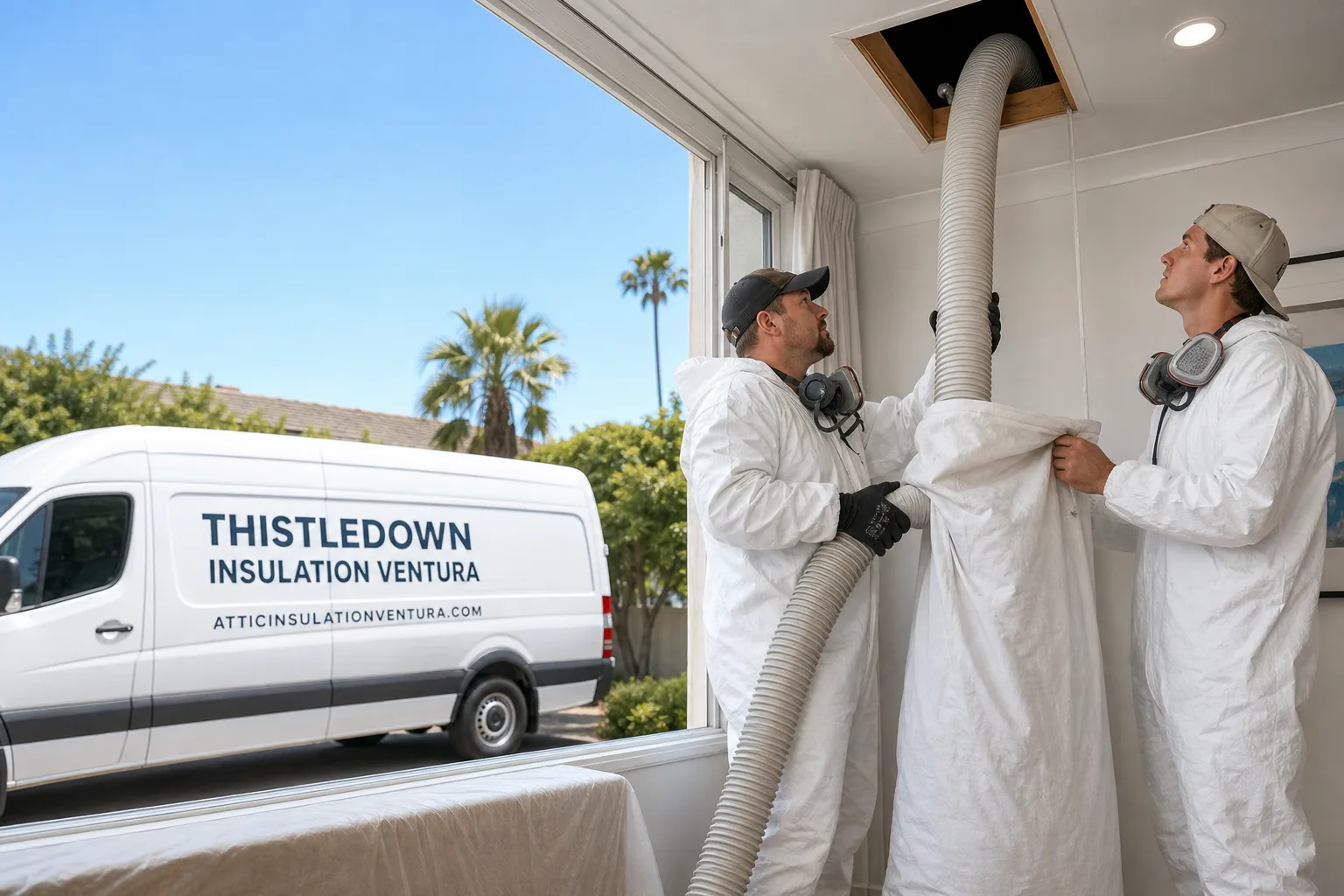
Fast, Reliable Spray Foam Insulation Across Fillmore
Spray foam insulation in Fillmore typically costs between $2,800 and $7,500 for an attic or wall retrofit, depending on the size of the home and the condition of the existing framing. Most jobs in Fillmore wrap up in one to two days, and our crews arrive in uniform with shoe covers and drop cloths from the front door to the attic hatch. We know Fillmore’s streets, from Central Avenue to the east-side tract ranches, and we answer every call with a live person at (341) 217-4867. You will have a written price before anyone picks up a tool.
Why Thistledown Insulation Ventura Is Fillmore’s Preferred Spray Foam Insulation Company
Fillmore homeowners keep calling us back because we treat the house the way they would, especially in older homes where the plaster walls are original and the orchard dust gets everywhere. Our technicians are background-checked and uniformed, so a parent home with a napping baby knows who is walking through the door. We do not send a rotating cast of subcontractors. The same crew that inspects the attic is the crew that sprays the foam and cleans up after.
We work in Fillmore’s 1920s bungalows off Central Avenue, the Spanish Colonial Revival homes near the historic downtown, and the post-1960s subdivisions on the east side. Each house type needs a different approach, and we have seen enough of them to know the difference. The Thistledown name is a promise about how carefully we work: thistledown is the soft fluff of the thistle, one of nature’s lightest insulators. It is the standard we hold ourselves to, from first call to final photo of the clean-up.
Every job is backed by the 365-Day Done Right Promise, and every Fillmore customer receives a written price before any work starts. Those are not optional upgrades. They are the baseline. Dispatch and scheduling are coordinated from our Los Angeles office, but the crews serving Fillmore are local and responsive to the valley’s schedule.
Garage Spray Foam Insulation in Fillmore
Garage Spray Foam Insulation in Fillmore is one of the most common upgrades we handle, because so many homes here have attached garages that turn into ovens by mid-afternoon and leach heat into the house all evening. The job involves spraying closed-cell foam onto the garage ceiling and the shared wall between garage and living space, air-sealing the gaps around the door framing, and often insulating the garage door header. Most Fillmore garage spray foam projects run $1,500 to $3,200, depending on square footage and whether we are also addressing the rim joist.
Shared-Wall Comfort
When a bedroom sits above or beside an unconditioned garage, that shared wall is a direct path for heat and dust. We spray the wall cavity and seal the top plate, which cuts the temperature swing in the room above. In Fillmore’s tract ranches on the east side, this is often the single biggest comfort fix we can make.
Door Opener and Track Access
We do not remove the garage door opener or its track. Our crews mask the opener, rails, and spring hardware with plastic sheeting before spraying, then pull the sheeting and wipe down every surface when the foam has set. The opener works exactly as it did before, just quieter because the space around it is now thermally sealed.
Closed Cell Spray Foam Insulation in Fillmore
Closed Cell Spray Foam Insulation in Fillmore is the go-to retrofit for the town’s older wood-framed homes, because it adds structural rigidity and blocks both air and moisture in a single pass. The material expands to fill 2×4 wall cavities and hardens to about 2 inches thick, which is often enough to bring a 1920s or 1930s wall to modern comfort standards without tearing out a single piece of plaster. Typical closed-cell wall retrofits in Fillmore run $4 to $7 per board foot installed, with whole-wall projects on a 1,200-square-foot home landing between $5,000 and $9,000.
Plaster-Preserving Retrofit
Fillmore’s older homes along Central Avenue and the historic downtown often have original plaster and lath interiors. Demolition is not an option for most of those homeowners, and it should not have to be. We drill small access holes through the exterior stucco or siding, inject closed-cell foam into the stud bays, and leave the interior walls untouched. The plaster stays. The character stays. The house finally holds heat in January and repels heat in August.
Orchard Dust Blocking
During Santa Ana wind events, fine dust from the citrus and avocado orchards around Fillmore pushes through every gap in an older home’s exterior. Closed-cell foam acts as an air barrier, not just insulation. It seals the cracks where dust was getting in, which means fewer particulates in the living space and a real difference for anyone in the house with allergies or asthma.
Trusted Brands We Service in Fillmore
We install and service insulation from Johns Manville, Knauf, CertainTeed, and Demilec, among the eight brands we carry. For Fillmore’s climate and housing stock, we find ourselves recommending Demilec closed-cell for wall cavity retrofits where moisture control matters, and Johns Manville or CertainTeed batt products for vented attic replacement work. Because we carry multiple lines, we match the product to the house rather than forcing one brand into every situation. We keep common product lines stocked for Fillmore-area jobs, which means less waiting when a homeowner calls on a Monday and wants the attic sealed before the next Santa Ana blows through.
Common Spray Foam Insulation Problems We See in Fillmore Homes
- Orchard dust packed into old wall cavities. Homes near the citrus and avocado acreage collect dust inside uninsulated stud bays during wind events. Closed-cell injection seals those cavities and stops the infiltration at the source.
- Cracked plaster from overzealous foam application. Closed-cell foam sprayed too thick in one pass generates exothermic heat that can crack aged plaster and lath. Our crews apply foam in controlled lifts sized for old walls, which prevents that damage.
- Neighbor overspray in dense lots. Fillmore’s older neighborhoods have tight setbacks. Uncontained foam drifting onto a neighbor’s car or window trim creates a bad situation. We mask and tent every spray zone, and we check the property line before spraying begins.
- Santa Ana dust bypassing an unsealed roofline. Spraying the roofline without first air-sealing the vented attic perimeter lets dust keep moving around the foam edges. We seal the perimeter first, then spray, so the barrier is continuous.
Pricing for Spray Foam Insulation in Fillmore, CA
Here is what Fillmore homeowners can expect to pay, based on the jobs we have completed in this valley:
- Garage ceiling and shared wall: $1,500 to $3,200
- Rim joist sealing in a crawlspace or basement: $900 to $2,200
- Closed-cell wall retrofit on a 1920s – 1950s home: $5,000 to $9,000, depending on wall area and access
- Attic roofline spray with air sealing: $3,800 to $7,500
- Open-cell attic floor application: $2,800 to $5,500
Square footage, roof pitch, and the condition of the existing framing all affect the final number, but the number is always in writing before any work begins. We do not quote a wide range and then surprise you later. Call (341) 217-4867 for a free estimate on your Fillmore home.
We Also Serve Cities Near Fillmore
Our crews work throughout the Santa Clara River Valley and the surrounding foothills. If you are in Moorpark, Santa Paula, Somis, or Simi Valley, we bring the same written pricing, the same background-checked crews, and the same Spray Foam Insulation standards to your home. To see how we serve Fillmore specifically, visit our Fillmore page for local details and project examples.
Serving Fillmore, CA - Our Local Coverage Area
We’re based in the Fillmore area and know this community well. Use the map below to see our service coverage - if you’re nearby, we can almost certainly help.
FAQs About Spray Foam Insulation in Fillmore
Spray foam, particularly closed-cell foam, creates an air barrier that blocks the fine dust blowing from surrounding citrus and avocado orchards. The foam seals the gaps where dust enters wall cavities and attic spaces, which means that dust stays outside. Call (341) 217-4867 and we can assess where dust is getting into your Fillmore home.
Yes. We drill small holes through the exterior and inject closed-cell foam into the uninsulated stud bays, leaving the interior plaster and lath completely intact. This is the only retrofit method that preserves vintage plaster while giving the wall cavity real insulation value.
Yes. Air sealing combined with spray foam typically reduces the air exchange rate in an older Fillmore home by 30 to 50 percent, which directly lowers cooling load. We recently insulated a 1930s Spanish Colonial Revival on Central Avenue where the owner saw a 40 percent drop in their cooling load the following summer. That is a measured result, not a brochure claim.
Yes, when applied by trained technicians in controlled lifts. Tight attics are common here, and the main safety concern is not foam chemistry but improper application. Our crews are trained in low-clearance attic work, and we use quiet tools when children are sleeping below. We also follow manufacturer specifications for re-entry times.
Yes. We mask the door opener, rails, and tracks with plastic sheeting before spraying, then remove the sheeting and wipe down all hardware when the foam has set. The opener stays in place and works normally, and the garage finally holds a reasonable temperature.
Written by Neil Barron, Owner at Thistledown Insulation Ventura, serving Fillmore and the Santa Clara River Valley since 2003.